El Niño Set to Intensify Further, Raising Global Weather Concerns
A strong El Niño is rapidly intensifying across the tropical Pacific and could become one of the most powerful events on record by late 2026. WMO and NOAA forecasts point to a major peak around the end of the year, with possible consequences for rainfall, heat, drought and extreme weather across several regions, including India.
New Delhi: A rapidly strengthening El Niño is expected to influence global weather patterns in the coming months, with climate agencies warning that the event could become exceptionally strong by the end of 2026.
The World Meteorological Organization (WMO) said in its latest July update that a strong El Niño is developing and is expected to intensify during August to October. Forecast models indicate that sea-surface temperature anomalies in key Pacific monitoring areas could reach around 2.9°C during this period, with the strengthening trend expected to peak around November.
NOAA's July assessment also points to an unusually powerful event. Its forecast gives an 81% probability of a very strong El Niño during October-December 2026, with the agency stating that such an event could rank among the strongest observed since records began in 1950.
The developing El Niño is being driven by rising temperatures across the tropical Pacific Ocean, accompanied by changes in atmospheric circulation. WMO has also forecast the development of a positive Indian Ocean Dipole, another climate driver that could influence rainfall and temperature patterns across the Indian Ocean region.
For India and other parts of South and Southeast Asia, the changing ocean-atmosphere pattern could increase the risk of below-normal rainfall in some periods, although the actual impact will vary by region and season. WMO's earlier seasonal outlook had already identified an increased probability of below-normal rainfall over the Indian subcontinent as El Niño strengthened.
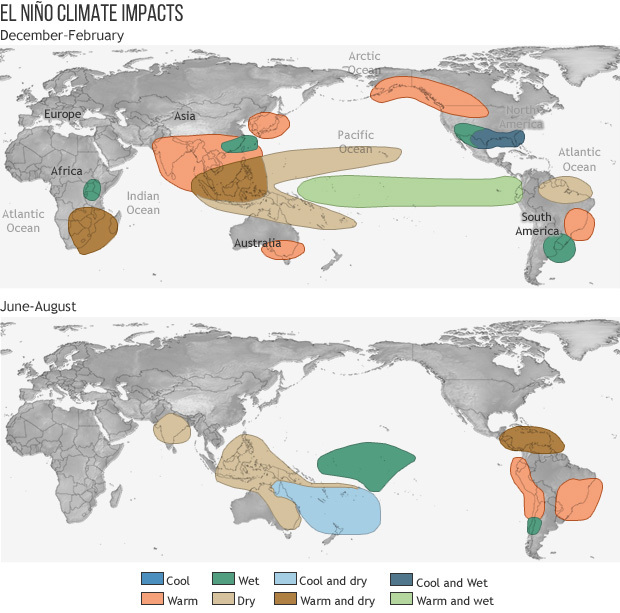
The effects are not expected to be limited to Asia. El Niño typically alters atmospheric circulation on a global scale, increasing the likelihood of heat, drought and rainfall extremes in different parts of the world. WMO has warned that the combination of a strong El Niño, exceptionally warm global oceans and a possible positive Indian Ocean Dipole could amplify regional risks, including droughts, floods and wildfires.
Climate agencies are therefore urging governments and vulnerable sectors such as agriculture, water management and health services to use seasonal forecasts for early preparation. While the event is increasingly likely to be very strong, its exact peak intensity and regional impacts will become clearer as the system develops.