PM Modi Independence Day Speech 2026: Sapt Dhara Roadmap, AI Training and Free Coaching Announced for Youth
Prime Minister Narendra Modi, in his 80th Independence Day address from the Red Fort on August 15, 2026, outlined a seven-point ‘Sapt Dhara’ roadmap for building a developed India by 2047. The framework focuses on manufacturing, agriculture and food production, technology and innovation, connectivity, defence, green and blue economy, and India’s soft power. PM Modi also announced AI skills training for 1 crore youth and a nationwide free online coaching network for competitive exam aspirants.
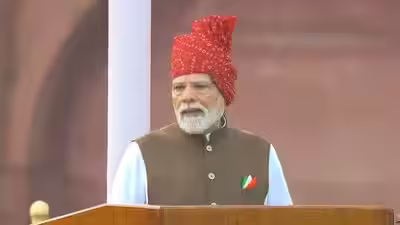
Prime Minister Narendra Modi on Saturday addressed the nation from the ramparts of the Red Fort on the occasion of India’s 80th Independence Day, laying out a roadmap for the country’s journey towards ‘Viksit Bharat’ by 2047.
In his address, PM Modi called for faster reforms, higher ambitions and a change in work culture across government, industry, agriculture and other sectors. He said India must increase the pace of development and accomplish in the next five to seven years what could not be achieved over several previous decades.
PM Modi’s ‘Sapt Dhara’ Vision for Viksit Bharat
A major highlight of the Independence Day speech was the Prime Minister’s ‘Sapt Dhara’, or seven streams of strength, which he presented as a roadmap to give India greater momentum over the next five to seven years.
1. Manufacturing Power
The first pillar is manufacturing. PM Modi called for India to develop complete value chains, from components and design to finished products, and emerge as a trusted global manufacturing and supply-chain hub.
He stressed three key priorities — cost, quality and scale — and said Indian products must meet global standards while maintaining strong quality and reliability.
2. Agriculture and Food Production
The second pillar focuses on agriculture and food production. The Prime Minister called for taking Indian agricultural products from farms to global markets and turning traditional foods, millets, spices, fruits and flowers into internationally recognised brands.
He also highlighted the importance of chemical-free farming and ensuring that Indian agricultural products meet global quality standards.
3. Technology and Innovation
Technology and innovation form the third pillar of the Sapt Dhara framework. PM Modi highlighted emerging fields such as Artificial Intelligence, quantum technology, space, robotics and data centres.
He said India should move beyond being a global market and work towards becoming an innovation hub. He also highlighted the ambition of taking Made-in-India 6G connectivity across the country.
4. Gati Shakti and Connectivity
The fourth pillar is Gati Shakti, focused on fast and seamless connectivity.
The Prime Minister highlighted high-speed rail, modern highways, inland waterways, airports and multimodal logistics hubs. He also called for ports to become engines of wider economic development rather than being limited to cargo handling.
5. Defence Power
The fifth pillar focuses on defence production and self-reliance.
PM Modi called for India to develop next-generation defence technologies and become a global supplier. He specifically highlighted drones, counter-drone systems, hypersonic technologies and cybersecurity as important areas for the future.
6. Green and Blue Economy
The sixth pillar focuses on the Green and Blue Economy.
The Prime Minister highlighted opportunities in renewable energy, green hydrogen, energy storage, green mobility and green manufacturing. He also pointed to India's coastline as a major opportunity for fisheries, coastal tourism and ocean technology.
7. India’s Soft Power
The seventh pillar is India’s soft power. PM Modi highlighted India’s strengths in Yoga, Ayurveda, holistic healthcare, handicrafts, culture, films, VFX, animation, gaming and digital content.
He also called for greater efforts to attract international tourists, sporting events and concerts to India.
Big Announcement for Gen-Z: 1 Crore Youth to Receive AI Skills Training
Youth empowerment was another major focus of the Prime Minister’s Independence Day address.
PM Modi announced a plan to provide AI skills training to 1 crore (10 million) young people in the coming year, with the aim of preparing India's youth for the rapidly expanding artificial intelligence economy.
The announcement places AI skills at the centre of the government's broader effort to prepare young Indians for future jobs and emerging technologies.
Free Online Coaching Network for Competitive Exams
In another major announcement aimed at students and young people, PM Modi said the government would establish a nationwide free online coaching network for competitive examinations.
The Prime Minister noted that the growing dependence on coaching institutes has placed a significant financial burden on many families. The proposed initiative is intended to make quality preparation more accessible to students, particularly those from poor and middle-class households.
Bigger Ambition for India by 2047
PM Modi also called on India to raise the scale of its ambitions. He said the country should aim for a larger presence among the world's leading companies, financial institutions, pharmaceutical companies and technology firms.
The Prime Minister stressed that Indian brands must become globally recognised for quality and reliability, while MSMEs should take advantage of India's trade agreements to expand into international markets.
Focus on Youth and Nation Building
The Prime Minister placed India's young population at the centre of the Viksit Bharat vision, arguing that the country's demographic strength can become a major driver of growth if young people are equipped with the right skills and opportunities.
From AI and emerging technologies to manufacturing, defence, innovation and the creative economy, the government is seeking to expand the role of India's youth in the country's development journey.
PM Modi's Independence Day address therefore combined a long-term 2047 vision with immediate priorities around skills, technology, manufacturing, infrastructure and self-reliance.